
Tags/SEO Keywords: E10 petrol, ethanol blending, fuel mixing formula, E20 petrol in India, how to mix petrol ethanol, car fuel tips, ethanol petrol compatibility, fuel economy ethanol, petrol ethanol calculator, vehicle maintenance India
Introduction
India is moving towards ethanol-blended petrol to reduce oil imports and emissions. Petrol at fuel stations is gradually shifting from E0 (pure petrol) to E20 (20% ethanol blend).
But here’s the issue:
👉 Many cars on the road today are certified only for E10 (10% ethanol blend).
Running these vehicles directly on E20 may cause problems in the long run — reduced mileage, higher wear on engine parts, and even voided warranties.
So, how can you safely manage this transition? The answer is simple: mix E0 and E20 in the right ratio to make E10.
Understanding the Fuel Types
- E0 Petrol → 0% ethanol (pure petrol)
- E10 Petrol → 10% ethanol, 90% petrol
- E20 Petrol → 20% ethanol, 80% petrol
If your car is certified for E10, the safest way to use E20 fuel availability is by blending it with E0 to achieve an overall 10% ethanol mix.
The Formula
To calculate the ethanol percentage in any mix, use this formula:
Ethanol % in final mix = ( (Liters of E0 × 0) + (Liters of E20 × 20) ) ÷ (Total Liters)
Since E0 has 0% ethanol, the formula simplifies to:
Ethanol % = (Liters of E20 × 20) ÷ (Liters of E0 + Liters of E20)For E10 fuel, you want the result to be 10% ethanol.
This means:
Liters of E20 = Liters of E0The Golden Rule
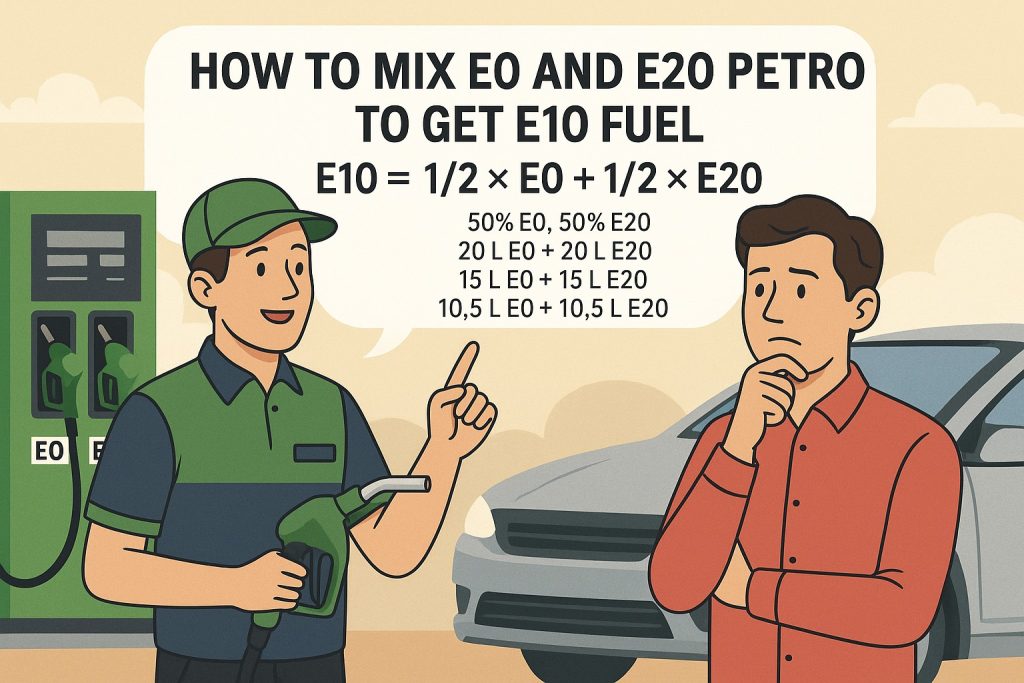
👉 To make E10 fuel: Mix equal parts E0 and E20.
That’s it. Half your tank E0, half your tank E20.
Practical Examples
Here are some ready-to-use combinations you can follow:
- 20 liters total → 10 L E0 + 10 L E20 = E10
- 30 liters total → 15 L E0 + 15 L E20 = E10
- 21 liters total → 10.5 L E0 + 10.5 L E20 = E10
- 40 liters total → 20 L E0 + 20 L E20 = E10
If your petrol pump allows you to measure in decimals (e.g., 10.5 L), you can be precise. Otherwise, staying close to the 50:50 ratio (even 60:40 or 40:60) will keep you safe — your car can tolerate small variations.
Why Not Run Purely on E20?
- Compatibility issues → Cars certified for E10 aren’t tested for long-term use of E20.
- Mileage drop → Ethanol has lower energy density, so E20 gives slightly worse fuel economy.
- Engine wear → Higher ethanol blends can affect rubber seals, injectors, and pumps not designed for it.
Occasional use of E20 won’t kill your engine, but for long-term health, it’s better to stay at or near E10.
How to Use This at the Pump
- Decide how much total fuel you want to fill.
- Divide that number by 2.
- Fill that much with E0 petrol.
- Fill the other half with E20 petrol.
Example:
If you want 25 liters total → 12.5 L E0 + 12.5 L E20.
Conclusion
As India transitions to ethanol-blended petrol, car owners of E10-certified vehicles can still refuel smartly without risk. The method is simple: mix E0 and E20 in equal amounts to create E10 fuel.
This way, you:
- Protect your car’s engine.
- Maintain fuel efficiency.
- Stay compliant with manufacturer recommendations.
It’s an easy, science-backed solution to adapt to the changing fuel landscape — one that every car owner can follow with confidence.
⚡ Pro Tip: Write this rule on a sticky note in your car or keep it on your phone:
E10 = Equal Parts E0 and E20
That one line is all you need to remember.